

Arm admitted the phone agent is a system problem.
I first used an Arm core in 1998. The constraint then was megahertz versus milliamps.
What Arm announced on 8 September as CSS for Mobile 2 is not a faster Cortex with a new letter. It is Arm saying, in product form, that an on-phone agent is not an NPU inference job. Speech, retrieval, reason, app launch, browse, action — that loop has to close inside a thermal box. The CPU is the orchestration engine. The GPU owns pixels, including the new neural ones. There is no NPU in the CSS. A partner who wants one attaches it. The interconnect is what keeps the 24 percent end-to-end number from falling apart.


Cortex did not vanish. The label did.
Most people still say Cortex-X and Cortex-A. That is the last generation that used those names in a mobile CSS. In 2025 Arm stopped putting Cortex on new application cores and started counting C1, C2. The ISA did not change families. Armv9-A is still Armv9-A. What changed is the product label, and the cluster grew a fourth tier.
The map, in the language you already have:
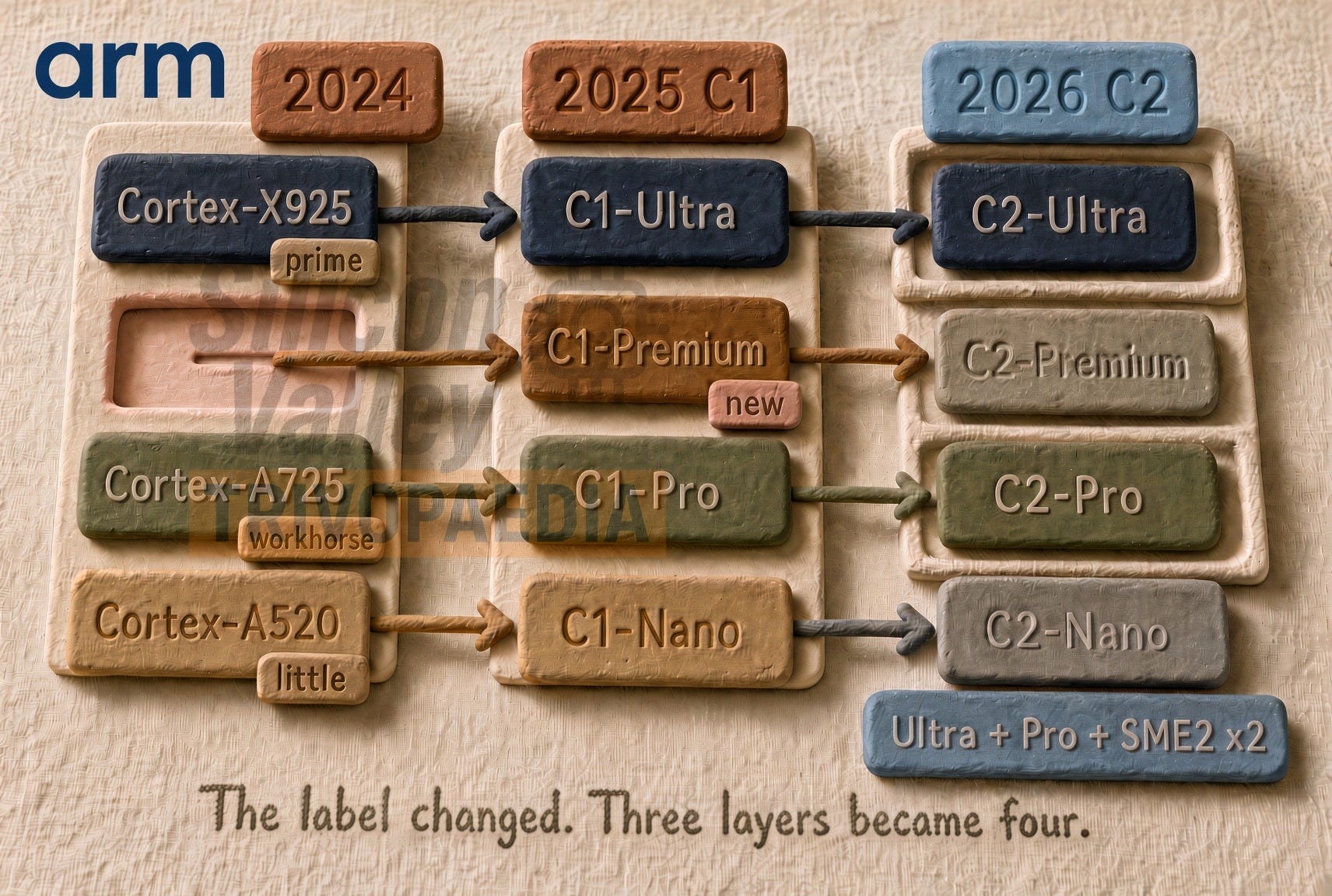
Premium is not A725 with a new badge. It is a shaved Ultra — same class of pipeline, less area. Three layers became four. C2 is the next microarchitecture on that four-layer map, not a new ISA and not the same silicon as a C1 phone already in a pocket.
Today’s CSS for Mobile 2 cluster, as Arm drew it, is C2-Ultra + C2-Pro + two SME2 (Scalable Matrix Extension 2) units. That is why the rest of this piece talks Ultra and Pro, not X and A7.
Cortex-M and Cortex-R did not move into this letter. An M85 is still an M85. Different profile, different article.
A CSS is a floor you can close. A core is not.
A core drop is an RTL view and a TRM. You take the core, you wrap a bus, you give it an interrupt map, you close timing against a memory system you designed yourself. That is a real job. It is also how a phone SoC used to eat a year after the ISA slide.
CSS — Compute SubSystem — is Arm selling the next layer up. CSS for Mobile 2 packages the C2 cluster, Mali G2-Ultra NX, the SI L2 interconnect (system interconnect — not CPU L2), a physical implementation, and a software reference: KleidiAI, the Neural Graphics Development Kit, AI Portal, MCP Server.
Physical implementation is the part most write-ups skip, and it is the part a back-end person actually buys. Arm is not handing you the GDS of a finished phone. It is handing you a timing-closed starting point: compiled memories, a clock and power grid that already survived a target process, isolation cells and RAM compilers you do not have to rediscover on the first place-and-route pass. Partners still own the modem, the ISP, the NPU if any, the DRAM PHY, and the skin. They can take the pieces independently or mix them with their own IP and third-party blocks.
That last sentence is the product. A CSS is a coherency story and a schedule story. It is not a locked SoC, and it is not “the next phone is an Arm reference design.”
The floor is drawn for a workload Arm is now calling agentic. The word is tired. The job is not. An agent does not emit a token and stop. It keeps task state. It decides where the next stage runs — a local model on SME2, a local app, a partner accelerator, or the network — and it comes back. Repeatedly. Under the same skin temperature you already know from flagship phones.
That is why the old scoreboard splits, and why a bigger core is the wrong unit of progress.
Single-thread latency still matters because the decisions are serial. Permission check. Tool pick. “Open this app.” Those do not parallelize. Multi-thread matters because retrieval, model prep, and the compositor do not wait for each other. Memory movement matters because none of those stages live in one SRAM. If you only ship a wider Ultra, you win the SPECint slide and lose the loop.
The C2 cluster: two kinds of CPU, and a matrix floor that is not a core
The cluster Arm is selling is C2-Ultra plus C2-Pro plus two SME2 units. Arm did not publish core counts, L2/L3 sizes, or the exact socket the matrix units sit in. I will not invent them. What is stated, and what a cluster person can still read, is the split of labor.
