

Company names in this industry do not last. Qorvo is the next one to go.
I first wrote that on 2 August, as an X Article, after dinner with a Qorvo engineer who said the name would disappear sooner than most people expected. Inside the company the rumor was already specific. An IT colleague had a date he had to be back from a trip. Some people treated that date as the last day of @qorvo.com. I do not know if the date was real. The fact that people were trading it was the story. They could already feel the end.
Six weeks later the calendar caught up with the rumor.
In October 2025 Skyworks and Qorvo announced a cash-and-stock merger valued at about $22 billion. Shareholders of both companies approved the deal on 11 February 2026. The U.S. antitrust wait is over. What remains, management keeps naming in public, is China’s SAMR review. At a Goldman conference last week Skyworks CEO Phil Brace said he was very confident the deal closes this calendar year, and that the company is preparing to close this fiscal year — Skyworks’ year ends 2 October. He put the image on the record: around the airport, waiting for permission to land.
Once it lands, Qorvo stops being an independent public company. The stock delists. The email domains change. The separate name fades into Skyworks.
The parts do not.
Two suppliers, one socket fight
For years Skyworks and Qorvo were the two large RF front-end houses selling into the same phones. Power amplifiers, filters, switches, antenna tuners, modules. They fought for sockets in iPhones and Galaxy phones. Apple in particular got what a buyer wants from that structure: two independent sources that could not treat a design-win as a permanent rent.
The same rivalry ran at Samsung. Qorvo kept a real position there — power amplifiers, filters, antenna tuning, Wi-Fi, ultra-wideband — with Samsung in the low teens of Qorvo revenue in recent years. Skyworks sold Samsung too, more selectively, on the high-performance side. In 2024 the two companies even announced a collaboration to put Skyworks’ SKY5 front-end into Samsung’s next 5G modem platforms. They were already acting like one supply base before the lawyers finished the merger.
That is the part of this deal that matters on a phone board. Two names that used to bid against each other will, after close, answer to one P&L.
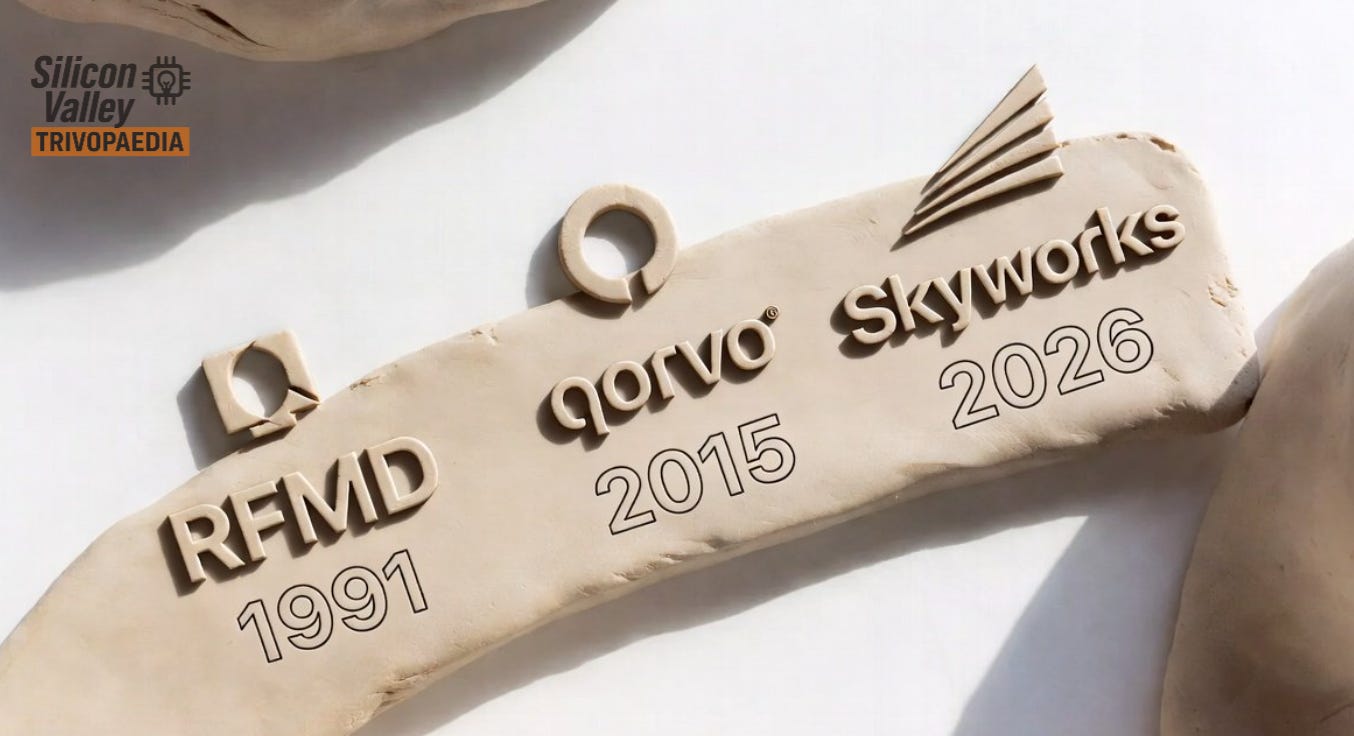
RFMD, TriQuint, then Qorvo
This is not Qorvo’s first renaming.
Qorvo was created on 1 January 2015 by the merger of RF Micro Devices and TriQuint Semiconductor.
RFMD was founded in 1991 in Greensboro, North Carolina, by three former Analog Devices engineers — William Pratt, Powell Seymour, and Jerry Neal. The company was built for commercial wireless, and for gallium arsenide HBT power amplifiers in handsets. By the late 1990s and 2000s it was one of the names you saw on the PA in a phone.
TriQuint is older. It spun out of Tektronix in Oregon in 1985. The name is a periodic-table joke: tri for group III, quint for group V — gallium arsenide. Early work was high-speed GaAs digital and analog. In 1991 it absorbed Gazelle Microcircuits and Gigabit Logic and pulled several of the early GaAs groups under one roof.
The 2015 combination took the Qorvo name and put headquarters in Greensboro. The portfolio got wider than handsets: infrastructure, defense, later IoT and power. For a little more than a decade Qorvo was the independent RF house that name referred to.
The same pressure, one more time
The forces that made RFMD and TriQuint into Qorvo are the forces making Qorvo into Skyworks. Scale. Customer concentration, especially Apple. The cost of staying in advanced filters, modules, and compound semiconductors when the customer list does not get longer.
If Brace’s calendar holds, the Qorvo name starts its formal retirement in the coming weeks, not the coming years. Business cards, badge systems, email, the ticker. Another familiar RF brand becomes a line in a corporate history.
RFMD became Qorvo. Qorvo is becoming part of Skyworks. Two suppliers that spent a decade competing at Apple and Samsung will operate as one.
The technology continues. The names usually do not.
This first ran as an X Article on 2 August 2026. The close window is what changed.